




Ren News
News
Meet the 98-year-old 'Angel of Route 66'
There is no sub title
Published: April 28, 2026
Angel Delgadillo still welcomes travellers to Seligman, Arizona – the town he fought to save when the "Mother Road" was forgotten.
On a dusty stretch of northern Arizona, about an hour west of Flagstaff, the neon glow of Angel and Vilma Delgadillo's Original Route 66 Gift Shop still flickers to life each morning.
Inside, 98-year-old Angel Delgadillo greets the stream of visitors pouring in from tour buses with a handshake and a grin bright enough to power its own neon sign. Its barely 09:00 but the shop is already buzzing with people from around the world searching for a tangible piece of nostalgia: Route 66-themed T-shirts, mugs, water bottles, key chains and other tchotchkes filling the store floor.
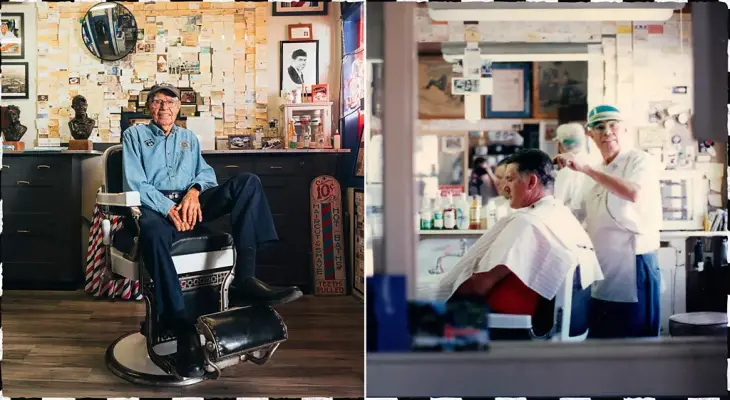
Delgadillo's tiny barbershop sits at the front of the shop, anchored by a single vintage barber chair that once sat in his father's own barber shop. The mirrored walls are covered with the business cards from the men who Delgadillo gave haircuts and shaves to for 75 years.
Before Delgadillo, Route 66 was fading into history. But thanks to him, today it's the US's most mythologised highway. In 2026, the "Mother Road" will celebrate its 100th anniversary, but without the spark Delgadillo kindled, a centennial celebration wouldn't have happened at all.
The man who wouldn't let the road die
Born in 1927, Delgadillo grew up in Seligman when its economy was centred around the Santa Fe Railroad. His parents had immigrated from Mexico a decade earlier, opening a pool hall and barber shop in 1922. The family was large; Delgadillo had three older brothers, three older sisters and two younger sisters.
"We had to make our own fun," he recalls. "Travellers would come into town in Model A's and Model T's. My father's house was painted white, and we would all run to the side of the house to make shadows in the headlights and play, watching our shadows move as the car moved. I grew up at a time when America had a much simpler way of life."
The glory days of Route 66
Dubbed the "Mother Road", Route 66 was established in 1926 as part of the US's first federal highway system, connecting Chicago to Los Angeles. Stretching more than 3,940km (2,448 miles) and passing through Illinois, Missouri, Oklahoma, Texas, New Mexico, Arizona and California, it carried more than 250,000 people west during the Dust Bowl and became a defining American road trip. Today, it is a pilgrimage for domestic and international travellers who come to celebrate the freedom of the open road and classic Americana.
Back then, Route 66 was a two-lane highway running through the centre of town. "The people travelling in the 1930s and early '40s were breaking down all along the way because they were so poor. As soon as you helped them get back on the road, another one was coming," Delgadillo says. "When people would come through on Route 66, they would stop and spend the night or stop and eat, and that was what travelling Route 66 was like back in those days. You're not trying to get anywhere fast, you're stopping in every town and enjoying it."
By the time Delgadillo returned from barber college to take over his father's shop, Route 66 was thriving, with around 9,000 cars coming through town each day. His brother Juan opened the now-iconic Delgadillo's Snow Cap, a drive-thru burger joint next door, while another brother, Joe, ran the garage and petrol station across the street.
Death of the Mother Road
In the late 1950s, high-speed four-lane highways began replacing sections of Route 66 as part of the expanding Interstate Highway System. By the 1970s, much of Route 66 had been superseded, causing towns all along the original road to wither.
"Our government finished building 100 miles (161km) of freeway from Kingman, Arizona, to Ash Fork, Arizona, on 22 September 1978," explains Delgadillo. "At about 14:30 in the afternoon, traffic in Seligman stopped. They opened up the highway and the travelling public took to it like ducks take to water."
Almost overnight, the entire community of Seligman was forgotten. The town's economy relied on passing traffic, and when Interstate 40 opened just two miles south of Seligman, its businesses suffered. Making matters worse, there was only one sign mentioning Seligman on the new 75-mile (121km) stretch to Flagstaff, appearing after the city of Ash Fork, where drivers would have already stopped to refuel. Angel and his brother Juan petitioned local officials for more signage, but even with the addition of four more, Seligman and its residents still suffered. Angel, Vilma and their four children couldn't afford to leave and start over somewhere else, even as business dried up and the family struggled to make ends meet.
There is no sub title



 Three enjoyable ways to slow your brain's ageing
4 days ago
Three enjoyable ways to slow your brain's ageing
4 days ago
 Why Eurovision's fallout over Israel may change the competition forever
4 days ago
Why Eurovision's fallout over Israel may change the competition forever
4 days ago



Comment has been disabled for this news